
How Much Does Young Driver Car Insurance Cost in the UK?

Car insurance is mandatory for all drivers in the UK, acting as a financial safety net against the risks of road travel. However, young drivers — typically aged 17 to 25 — often face significantly higher insurance costs than more experienced motorists.
This happens because insurers classify young drivers as higher-risk due to limited driving experience and a greater likelihood of risk-taking behaviours. As a result, premiums for this group are often several times higher than for older drivers.
By law, every driver must hold at least third-party insurance to cover liability for injury or damage caused to others. Understanding coverage options and pricing is therefore essential for young motorists.
Key factors influencing young driver car insurance costs include:
- Driver profile → Age, driving experience, and claims history.
- Vehicle type → Engine size, safety ratings, and repair costs.
- Location → Urban areas usually have higher premiums due to theft and accident rates.
- Legal requirements → Minimum coverage is compulsory under UK law.
This article explores why young driver premiums are higher, the types of coverage available, how insurers calculate costs, and strategies to reduce premiums. By understanding these factors, young drivers can make informed financial decisions and choose the most suitable policy.
Factors Affecting Young Driver Car Insurance Costs
Young driver car insurance costs in the UK are influenced by multiple factors that insurers evaluate to determine risk levels. The younger and less experienced the driver, the higher the likelihood of accidents, which typically results in more expensive premiums.
The most significant factors include:
- Age & driving experience → Drivers under 25 are statistically more likely to be involved in accidents, which leads insurers to classify them as higher risk.
- Vehicle type → Cars with powerful engines, high repair costs, or those commonly targeted by thieves increase premiums. Engine size, car value, and safety ratings are critical considerations.
- Location → Urban areas, especially London and other big cities, usually face higher premiums due to increased theft, vandalism, and traffic accidents, while rural areas tend to have lower costs.
- Claims & driving history → Past accidents, driving offences, and licence endorsements significantly impact premiums. Conversely, a clean record helps reduce costs over time.
- Annual mileage → Higher mileage increases exposure to risk, which drives premiums up. Insurers calculate expected claim likelihood based on usage data.
Insurers rely on extensive statistical models showing a strong correlation between youth, inexperience, and riskier driving behaviours.
By understanding these factors and managing them strategically — such as choosing safer cars, driving fewer miles, and maintaining a clean record — young drivers can reduce insurance costs and access more affordable options.
Types of Car Insurance Available for Young Drivers
Young drivers in the UK can choose from three main types of car insurance, each offering different levels of coverage, protection, and cost. Selecting the right policy depends on factors such as vehicle value, driving frequency, and budget.
The main types of policies are:
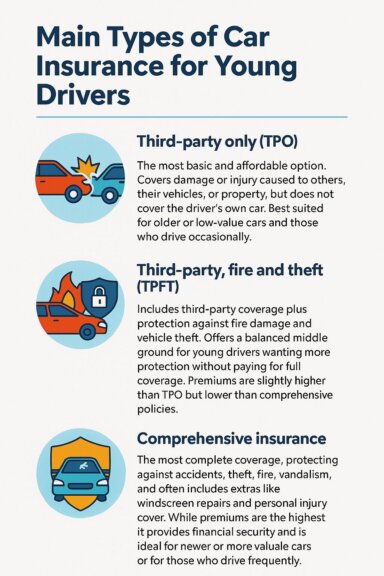
Choosing the right policy depends on the balance between monthly premiums and financial protection:
- For drivers with older, low-value cars, a third-party policy might be enough.
- For those commuting daily in newer vehicles, comprehensive coverage offers greater security and fewer out-of-pocket expenses.
Understanding these policy types enables young drivers to plan insurance costs effectively and select the best option based on budget, vehicle type, and driving habits.
Strategies to Reduce Young Driver Insurance Premiums
Young drivers in the UK often face high insurance premiums, but several effective strategies can help lower these costs. Insurers calculate prices based on risk factors, so adopting safer habits and making smarter choices can lead to significant savings.
Key strategies to reduce premiums:
- Choose a low-powered car → Opting for a vehicle with a smaller engine, lower repair costs, and better safety ratings can significantly reduce premiums.
- Add an experienced driver → Including a parent or guardian as a named driver spreads risk and signals responsible driving, but the young driver must remain the main user to avoid “fronting”, which is illegal.
- Increase voluntary excess → Agreeing to pay a higher out-of-pocket amount in case of an accident can lower premiums. However, balance this carefully to avoid financial strain.
- Use telematics (“black box”) policies → These devices monitor driving behaviour, rewarding safe driving with reduced premiums over time. Ideal for tech-friendly drivers who want personalised pricing.
- Complete advanced driving courses → Programs like Pass Plus improve driving skills and demonstrate responsibility to insurers, often resulting in discounted rates.
Each strategy works differently depending on driving habits, financial flexibility, and vehicle type. For example, telematics benefits drivers confident in their skills, while increasing excess may suit those with lower risk profiles seeking immediate savings.
Evaluating personal circumstances helps select the best mix of approaches to achieve more affordable insurance.
The Role of Legal Requirements and Government Initiatives
Young drivers in the UK face specific legal obligations regarding car insurance, aimed at ensuring minimum protection for all road users.
By law, every driver — including those under 25 — must hold at least third-party insurance. This covers damage or injury caused to others, but does not protect the driver’s own vehicle.
Insurance providers are regulated by government legislation, which defines the framework for policy structures and pricing.
Insurers must offer minimum coverage options but can also provide enhanced protections, such as comprehensive policies or third-party, fire and theft plans, usually at higher premiums.
The UK government also supports young drivers through initiatives designed to reduce insurance costs and encourage safer driving habits. Examples include:
- Young Driver Initiative → Promotes road safety awareness through educational campaigns.
- Pass Plus scheme → Offers discounts on insurance premiums for completing an advanced driving course, demonstrating improved skills.
- Telematics-based policies (“black box” insurance) → Encouraged under UK legislation, these reward responsible driving with lower premiums.
Additionally, government regulations require transparency in premium calculations. Insurers must justify pricing using objective risk factors, such as age, driving history, and vehicle type.
By understanding these legal requirements and leveraging government-backed initiatives, young drivers can identify compliant policies, unlock potential discounts, and make car insurance more affordable and accessible.
Comparing Insurance Providers and Using Technology to Find the Best Deals
For young drivers in the UK, shopping around for car insurance is essential to finding the best deals and avoiding overpaying.
Premiums can vary significantly between providers due to different risk assessments, discount policies, and exclusive incentives.
Comparing multiple quotes gives young drivers a clearer view of the market and helps secure more affordable coverage tailored to their needs.
Ways technology helps young drivers save:
-
Use comparison platforms → Websites and apps provide multiple quotes instantly, often with filters designed for young drivers, including telematics discounts and no-claims bonuses.
-
Manage policies via mobile apps → Drivers can track claims, view coverage, and monitor driving behaviour in real time, which may lead to lower premiums for safe driving.
-
Leverage telematics (“black box”) insurance → Apps track speed, braking, and driving patterns; safer driving often results in personalised discounts.
-
Compare full coverage, not just price → Always review policy excesses, optional extras, exclusions, and available discounts before committing.
Reading the fine print is crucial to avoid unexpected costs, such as hidden fees or claim restrictions. Additionally, some insurers provide extra discounts for advanced driving courses, academic achievements, or secure parking arrangements.
By combining comparison tools, mobile technology, and telematics insights, young drivers can make informed decisions, ensuring their insurance remains affordable, flexible, and aligned with their needs.
For deeper insights into managing credit and insurance costs, resources like the TSB Platinum Purchase Credit Card guide offer useful financial tips that complement careful insurance shopping.
Conclusions
Young driver car insurance in the UK is understandably more expensive due to the higher risk associated with inexperienced drivers.
However, by understanding the various factors that influence premium costs, exploring different insurance types, and employing strategies to lower expenses, young drivers can find affordable and appropriate coverage.
Awareness of legal requirements and leveraging technology to compare providers further empowers young motorists to navigate this essential aspect of driving responsibly and economically.
Ultimately, informed choices help young drivers maintain financial control while staying protected on the road.
About the author

I have completed studies in law and marketing, and professionally I specialize in creating strategic content, branding, and social media management. I’m passionate about finance and communication, and my mission is to simplify complex topics and deliver valuable, accessible information. I’m communicative, organized, and I love fashion and good shopping. In my free time, I enjoy spending time in nature, cooking, traveling, and consuming content that sparks my curiosity and desire to learn.


