
Personal Budgeting for Saving Simple Methods

Effectively managing personal finances is the cornerstone of achieving financial stability and independence. The most fundamental tool for this is personal budgeting—a deliberate plan that coordinates income and expenses to control spending, mitigate debt, and meet saving goals.
Budgeting is not just about restricting expenditure; it is an opportunity to actively take control of your money, ensuring funds are allocated according to your priorities and long-term aspirations.
This article explores simple and practical personal budgeting methods designed to empower you to save money consistently and successfully.
Whether you are a beginner or looking to refine an existing strategy, understanding approaches like the 50/30/20 rule, the ‘pay yourself first’ method, the envelope system, zero-based budgeting, and Kakeibo will provide the foundation for successful money management.
By applying these techniques, you can develop a financial routine that minimises stress, maximises savings, and prepares you for the future.
Understanding the Basics of Personal Budgeting
Personal budgeting is the crucial foundation for effective financial management. Essentially, it serves as a roadmap guiding your spending and saving decisions over a specific period (typically monthly).
Its primary goal is to help you consciously allocate your net income to achieve specific financial goals, such as building an emergency fund, paying off debt, or saving for major purchases, thus ensuring your money aligns with your long-term priorities.
This process is essential for reducing financial stress and maintaining control.
The Practical Steps to Creating a Budget
Creating and maintaining a functional budget involves a sequence of practical steps. To gain control and structure, focus on the following core activities:
-
Calculate Net Income: Determine the exact amount of money you take home after all deductions, as this is the basis of your budget.
-
Track and Categorise Expenses: Meticulously monitor your spending, differentiating between fixed costs (constant, e.g., rent) and variable costs (fluctuating, e.g., groceries).
-
Establish Financial Goals: Define clear, realistic, and motivating objectives that give your budget a purpose.
-
Plan and Prioritise Allocation: Consciously decide how much to spend on needs, save/invest, and allocate for discretionary spending.
-
Review and Adjust Regularly: Ensure the budget remains relevant and effective by updating it whenever your income, expenses, or goals change.
By following these steps, you gain the financial control necessary to make informed choices, build savings, reduce debt, and secure your future.
Implementing the 50 30 20 Rule for Balanced Budgeting
The 50/30/20 Rule offers a straightforward, effective framework for managing your money.
It simplifies budgeting by dividing your after-tax income (net income) into three clear categories, assigning fixed percentages to each area.
This makes it an excellent method for beginners seeking to balance spending and saving without the complexity of rigid itemizing.
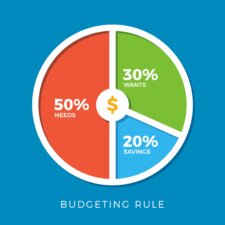
The Allocation Breakdown
The rule divides your net income into the following essential categories:
-
50% for Needs: These are the essential expenses you cannot avoid, such as rent/mortgage, utilities, essential groceries, healthcare, transportation, and minimum debt payments. Be realistic about what truly qualifies as a need.
-
30% for Wants: These are non-essential items that enhance your lifestyle but are not vital. Examples include dining out, entertainment, vacations, and subscription services. Managing spending within this limit encourages conscious choices.
-
20% for Savings and Debt Repayment: This portion is crucial for building financial security and reaching long-term goals. It includes contributions to emergency funds, retirement accounts, investments, and paying off debts beyond the required minimum.
Advantages and Practical Application
The biggest advantage of the 50/30/20 rule is its simplicity and flexibility. It provides clear boundaries but allows you to adapt expenditures as your life changes.
For practical application, you should:
-
Track Everything: Meticulously track your monthly income and expenses.
-
Categorise Honestly: Assign each transaction to the correct category (Need, Want, or Savings/Debt).
-
Calculate Compliance: Use budgeting tools to ensure your spending aligns with the fixed percentages.
Consistently following this rule helps maintain financial discipline, reduces money-related stress, and supports balanced spending aligned with your priorities.
Mastering the Pay Yourself First Principle
The ‘Pay Yourself First’ principle is a powerful, straightforward budgeting method that prioritises saving.
This approach reverses traditional financial management by ensuring a predetermined portion of your income is automatically set aside for savings before any funds are allocated to other expenses.
By doing this, saving becomes a non-negotiable priority rather than an afterthought.
Implementation and Structure
A common starting point for implementation is the 80/20 split, where 20% of your net income goes directly into savings or investments, and the remaining 80% covers all living expenses.
This division encourages disciplined saving habits. However, this ratio can be adjusted (e.g., 70/30 or 60/40) based on your financial goals.
To add structure and clarity to this strategy:
-
Automate Savings: Set up automatic transfers to your savings accounts immediately after pay day.
-
Create Sub-Savings Accounts: Instead of one general savings pot, use separate accounts for specific goals (e.g., emergency fund, retirement, house deposit, vacation).
-
Assign Monthly Targets: Break large objectives into manageable monthly chunks to foster consistent saving and maintain motivation.
Key Benefits
Prioritising savings first is invaluable for establishing long-term financial security:
-
Builds a Robust Safety Net: Earmarking savings upfront steadily accumulates resources for an essential emergency fund.
-
Establishes Discipline: It makes wealth building a natural, disciplined part of your routine.
-
Accelerates Goal Achievement: Adjusting the savings ratio (e.g., to 30% or 40%) can rapidly accelerate progress towards major goals like homeownership.
Over time, this disciplined habit transforms your financial outlook, giving you confidence and control over your future.
Utilizing Cash and Zero Based Budgeting Techniques
Two powerful and complementary methods for maintaining strict spending control are the Envelope Method (cash-based) and Zero-Based Budgeting (ZBB).
Both techniques demand full awareness of your income and expenses, instilling accountability and preventing overspending.
The Envelope Method is a straightforward, cash-only system:
-
You physically divide cash into envelopes, each labelled for a specific expense category (e.g., groceries, entertainment).
-
Once the cash is spent, no more money is available for that category until the next period.
-
This tactile approach prevents reliance on credit and makes the consequences of overspending immediate, enhancing mindfulness and stopping impulse buys.
Zero-Based Budgeting (ZBB) takes a comprehensive approach by ensuring that every dollar of income is assigned a specific job until your budget totals zero.
-
This means your Income minus Expenses (including savings and debt) must equal zero ($\text{I} – \text{E} = 0$).
-
ZBB forces you to plan down to the last dollar, giving you complete control and eliminating waste.
-
It promotes comprehensive financial awareness by requiring you to deliberately decide where each dollar goes, ensuring intentional spending aligned with your priorities.
While the Envelope Method excels at managing daily variable expenses, ZBB shines in overall money management and prioritisation.
Using these techniques together creates a robust framework that keeps spending controlled and purposeful, helping you save consistently and avoid financial surprises.
Applying Kakeibo for Mindful and Reflective Budgeting
The Japanese budgeting method, Kakeibo, offers a uniquely mindful and reflective approach to managing household finances.
Unlike techniques focused purely on calculations, Kakeibo emphasises the thoughtful tracking of income and expenses to cultivate greater financial awareness and intentional spending habits.
Core Practices of Kakeibo
At the heart of Kakeibo is meticulous recording and categorisation, combined with regular review:
-
Log Income First: A clear overview of available resources is established by logging all earnings at the start of the cycle.
-
Set Savings Goals: A target savings amount is established monthly, creating a purposeful intention that guides spending decisions.
-
Categorise Expenses: Spending is divided into fixed costs (e.g., rent, subscriptions) and discretionary expenses.
The Role of Reflection
Regular reflection is what truly distinguishes Kakeibo. Each week or month, users review their spending records and contemplate:
-
Why certain purchases were made.
-
Whether spending aligned with their values.
-
How to improve the next month’s budget.
This reflective practice helps reduce impulsive buying by increasing awareness of spending triggers and patterns, transforming budgeting from a chore into a mindful habit that enhances financial discipline and emotional satisfaction with spending choices.
Conclusions
In conclusion, personal budgeting is a powerful tool for saving money and achieving financial goals.
Using simple methods like the 50/30/20 rule, pay yourself first, the envelope system, zero-based budgeting, and Kakeibo can help individuals gain control over their finances.
These techniques encourage mindful spending, systematic saving, and thoughtful financial planning.
By consistently applying a budgeting method that fits one’s lifestyle, anyone can build a secure financial future, reduce stress over money, and enjoy the benefits of sound money management.
About the author

I have completed studies in law and marketing, and professionally I specialize in creating strategic content, branding, and social media management. I’m passionate about finance and communication, and my mission is to simplify complex topics and deliver valuable, accessible information. I’m communicative, organized, and I love fashion and good shopping. In my free time, I enjoy spending time in nature, cooking, traveling, and consuming content that sparks my curiosity and desire to learn.


